
Google Search Console is a great tool but misses some functionalities like
- Advanced Data Visualization: It lacks the ability to instantly aggregate performance data in the table by week, month, or quarter to see broader traffic trends.
- Complex Filtering: There are no built-in RegEx presets or easy ways to filter for specific intents (like „questions“) or technical criteria (like „URLs without a trailing slash“) without manual input.
- Bulk Report Consolidation: It doesn’t allow you to combine multiple Indexation or Crawl Stats reports into a single, comprehensive overview with one click.
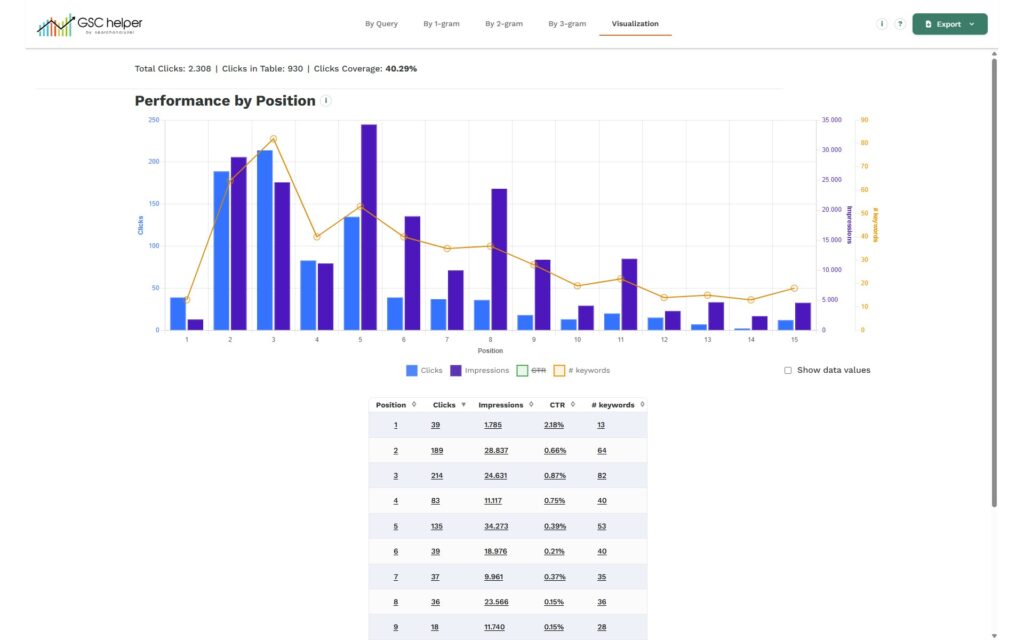
- Granular Query Analysis: Native GSC doesn’t provide detailed metrics like n-grams, word counts, or keyword coverage percentages for your search queries.
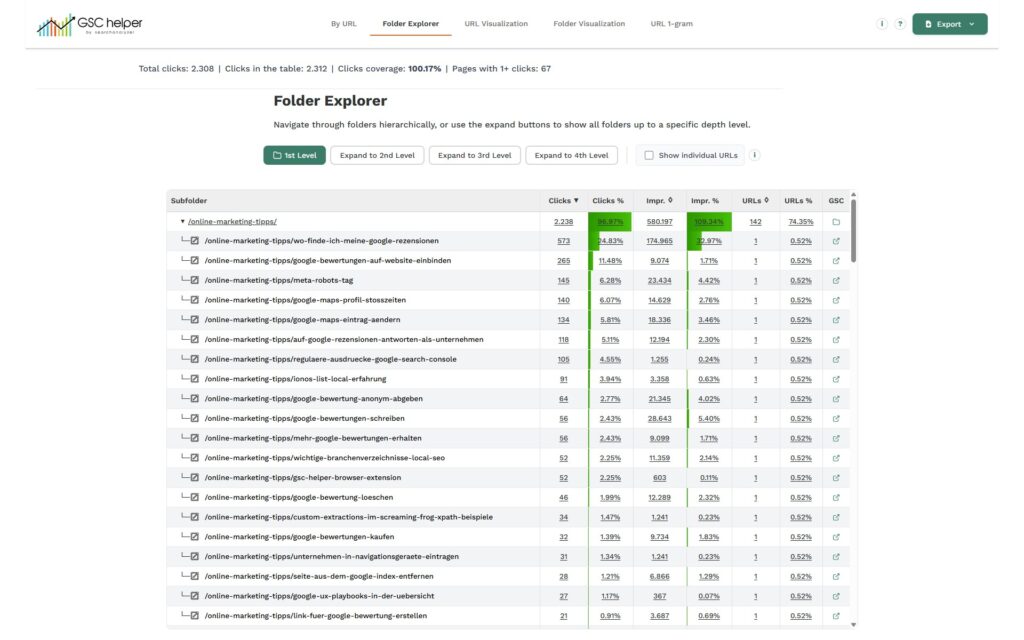
- Hierarchical Traffic Insights: There is no native visualization tab to automatically analyze and compare traffic share by URL or folder.
- Flexible Date Comparisons: Selecting non-standard ranges (e.g., „Quarter to Date“ or „Last Month vs. One Year Ago“) requires several manual clicks instead of a quick-access menu.
- UI Productivity Shortcuts: It lacks simple „quality of life“ features like row numbers, a „Copy-to-Clipboard“ button for tables, or the ability to extract sample URLs from error reports instantly.
- Multi-Account Efficiency: Switching between different Google accounts often leads to losing your current filters or report settings.
- Quick External Lookups: It doesn’t offer an integrated way to jump from a reported search query directly to a Google Search or pass a URL to Google Search Console.
That’s why you need the free GSC Helper extension for your Chrome browser. Get the extension now!

See GSC Helper in action
Does the extension require my Google Account login or API access?
Only when you want to use the Google Search Console API features. By default, GSC Helper does not require OAuth access or API keys. GSC Helper acts as a visual overlay, displaying the data from your current Google Search Console view in a nicer way by parsing the source code. The data is not send to us or any third party.
How do I use the extension?
Simply click the extension icon, the buttons in the „GSC Helper action bar,“ or use the right-click context menu while viewing your Google Search Console (GSC) report. GSC Helper automatically analyzes the data on your screen to add helpful visualizations and insights.
🔒 Privacy First: All processing happens locally in your browser. Your data is never sent to us or third parties.
Is GSC Helper an official Google product?
No. GSC Helper is a third-party browser extension. Google Search Console and its data remain Google’s; the extension only helps you use that interface more efficiently.
How does GSC Helper query different Search Console reports and combine the results?
GSC Helper uses your active Google Search Console session. For bulk exports (for example from Report Downloads), it builds the same kind of requests the Search Console UI uses—each report type maps to the appropriate Search Console URL with your property (resource_id), report parameters, and export format. Your browser then requests those files.
For views that need more detail than a single export can provide at once, the extension may run several exports in sequence (for example with different report IDs) and merge the rows in your browser—typically by URL or another stable key—so you get one combined picture without double-counting where the logic is designed to avoid overlap.
In all cases, the underlying numbers still come from Google; the extension organizes, merges, and presents them—it does not replace Google’s reporting engine.
Why does the extension ask for permissions like tabs, storage, or downloads?
We limit the permission requests as much as possible. Due to the design of Google Chrome, some information is unavailable without those permission rights.
E.g. Tabs and scripting allow the extension to interact with open Search Console tabs and retrieve data. Storage permission is used to save your settings. „All sites“ access is needed to create links to Google Search Console; without it, we would not know which domain or URL to pass.
The toolbar or buttons do not show up. What should I do?
Google Search Console is a „Single Page Application“ (SPA). Sometimes the plugin attempts to inject the buttons before the GSC interface has finished loading.
Try a Hard Refresh: Press
Ctrl + F5(Windows) orCmd + Shift + R(Mac).Wait 2–3 seconds after the page loads to see if the buttons appear.
Can I turn off notifications or specific injected features?
Yes— open the extension’s options page and disable what you do not need.
Does the extension work if my Search Console is set to a language other than English?
Yes, GSC Helper is built to be language-agnostic. It identifies data structures within the interface regardless of whether your GSC is set to German, English, or any other supported language.
Can I only allow GSC Helper to only run on certain websites?
Yes, you can easily restrict GSC Helper to only run where you need it.
Right-click the GSC Helper icon in your toolbar.
Hover over „This can read and change site data.“
Choose your preferred level of access:
When you click the extension: The extension stays „off“ until you manually click it.
On domain.tld: It will only activate when you are on specified domains.
On all sites: (Default) It stays active everywhere.
What causes data being incorrect / not shown?
Google Search Console is a single page application (SPA) and keeps prior visits in the source code. As a result, you may see incorrect or missing data when changing views or properties. To ensure that only the current data is in the source, refresh the page.
What is the difference between GSC Helper and searchanalyzer.io?
GSC Helper is a browser-based „workflow booster“ for immediate, on-the-go analysis of your current view. Searchanalyzer.io is our full platform designed for long-term data monitoring, deep content optimization, and strategic performance tracking across your entire history.
Key Features
Combine sample reports within seconds
GSC Helper requests and combines Google Search Console exports for you. Instead of manually downloading e.g., crawl stats or index coverage reports and combining them, let GSC Helper do the work for you. Within seconds, powerful reports with flexible filters are available in your browser.
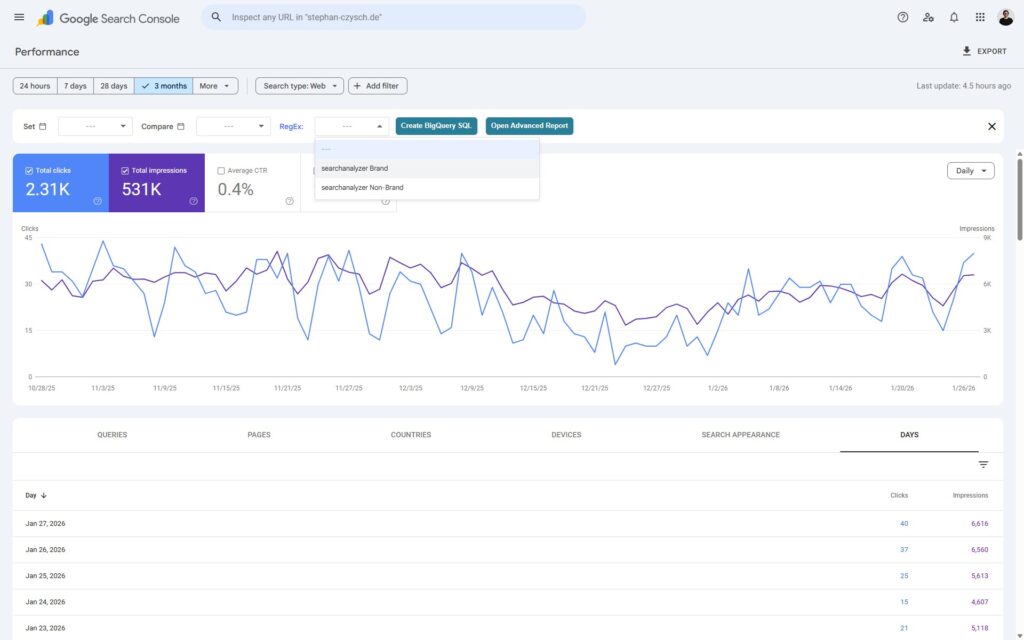
Load custom and preset RegEx filters
Besides preset RegEx filters for URLs and queries (like word counts, AIO, and Fan-Out-Queries!), you can define your own custom RegEx filters in the options! Do you want to easily separate brand and non-brand queries? Or exclude a specific folder? Set up your custom regex and load them from the context menu!
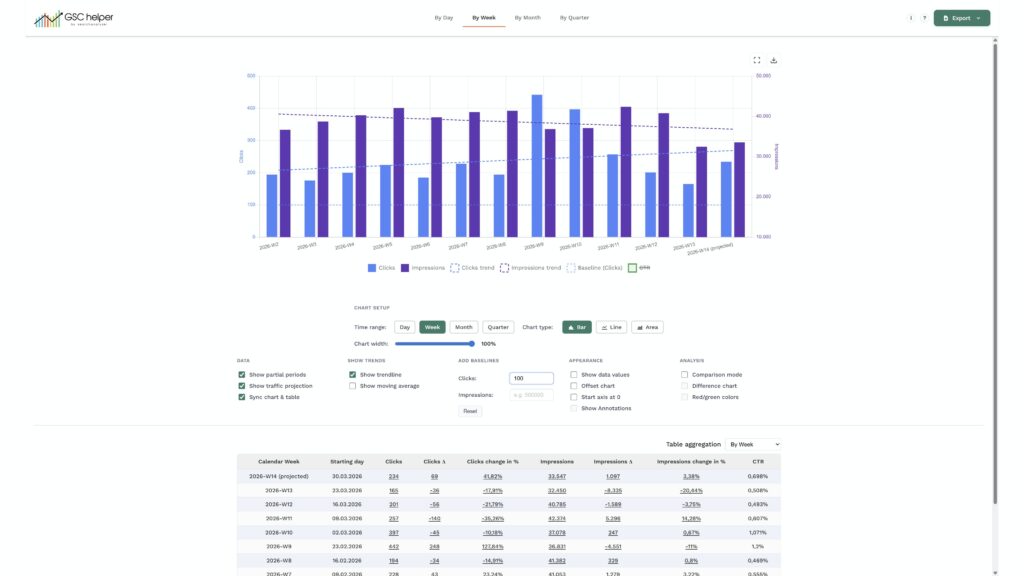
Visualize your performance data by weeks, months, or quarters
One of the most loved features of GSC Helper is the performance data visualization.
- Configure GSC performance report as you need it, especially set the time frame longer than 1 month
- Switch to „dates“ dimension in the performance report
- Click the plugin logo
- Adjust the time frame for the chart to your needs and see, e.g., monthly trends
The extension supports all GSC performance reports („Search results“, „Google News“ and „Discover“).
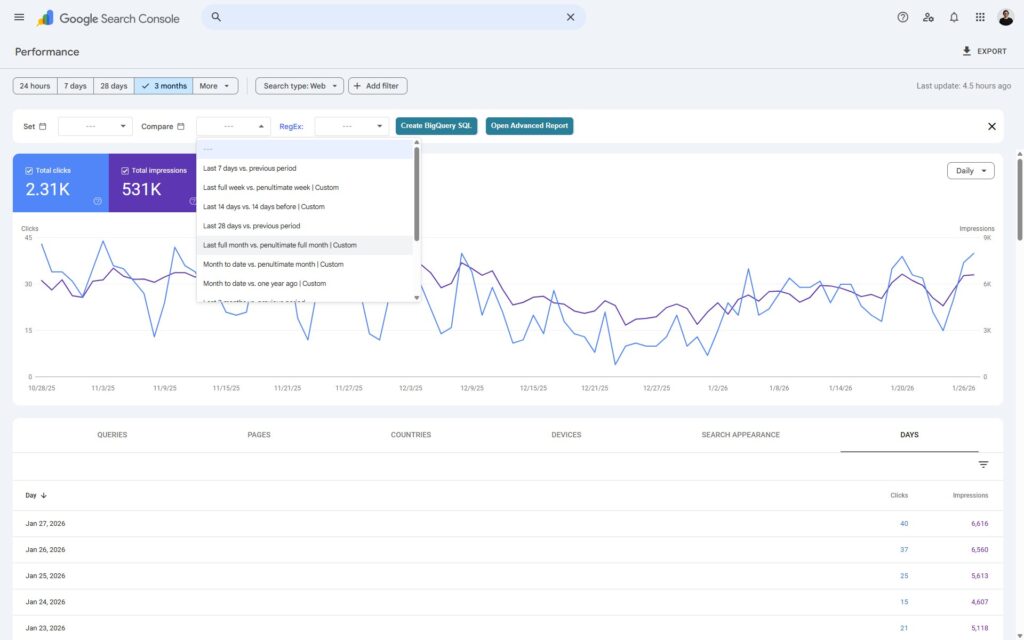
Easily set dates
Setting dates in Google Search Console can be painful. That’s why you can select common date periods with just one click. Perform a right mouse-button click and set dates with ease.
Analyze your page traffic
For most websites, only a few pages are the core traffic drivers. While you view your page data in GSC, you can create an enhanced table that provides the traffic share of each URL and sums up the data by folder.
Advanced Query insights
Do you know that Google Search Console is usually only providing 30 to 40 % of all queries with clicks? Analyze your query clicks coverage with ease! Let GSC Helper split your search queries into n-grams, and view clicks & impressions aggregated by position.
How does GSC Helper work?
Everything happens locally in your browser. By your demand, the plugin parses your source code and visualizes your GSC data just for you. No data is transferred to us. See the FAQ for more details.
Where can I obtain the plugin?
The plugin is available for Chrome. Get it from Chrome Web Store now.
Check the update notes
Wondering how GSC Helper evolved over time? Review the update notes. All functions can also be viewed in the FAQ.
How to use the plugin?
Once you’ve added the extension, clicking its logo will either open the current URL in GSC (if you’re outside GSC) or enhance the data view in your active browser tab. These features work in specific views, like query, page, and date.
You can also access all available actions by right-clicking and choosing from the context menu. GSC Helper offers two types of actions: „General website actions“ to open a page or domain in GSC and „GSC-specific actions“ to create enhanced tables, set filters, or adjust the date range in reports.
Whom to say thanks to?
Stephan Czysch is the creator of this free extension (connect on LinkedIn). He is a Berlin-based online marketing expert and founder of searchanalyzer. Searchanalyzer enables search professionals to gain more profound insights into their current organic Google traffic and helps optimize existing content.
